Synthetic Generator
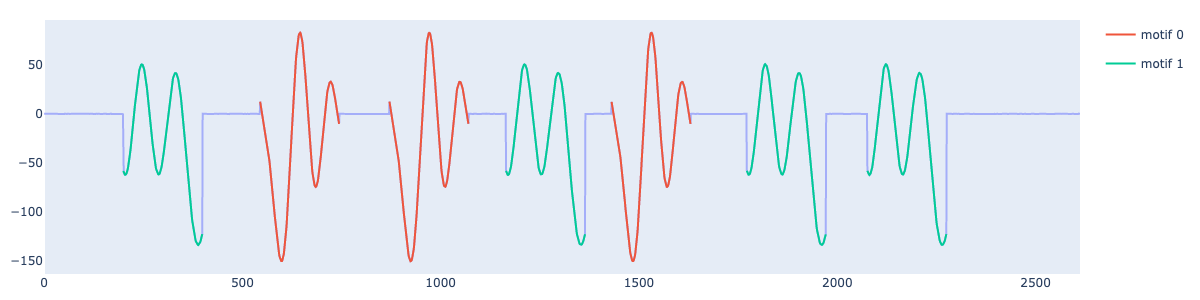
This section introduces the synthetic time series generator used to produce data for investigating research questions 2 to 6.
- class tsmd.tools.synthetic_signal.SignalGenerator(n_motifs: int, motif_length=100, motif_amplitude=1, motif_fundamental=1, motif_type='Sin', noise_amplitude=0.1, n_novelties=0, length_fluctuation=0.0, amplitude_fluctuation=0.0, sparsity=0.2, sparsity_fluctuation=0.0, walk_amplitude=0.0, min_rep=2, max_rep=5, exact_occurences=None, exact_ts_length=None)
Synthetic signal generator.
- Parameters
n_motifs (
int) – Number of different motifs.motif_length (
intorlistofint, default100) – Length(s) of the motifs to be generated. If an int is provided, it is interpreted as a constant length used for all motifs (i.e., a list of length n_motifs filled with this value). If a list is provided, it should contain exactly n_motifs elements, where each value specifies the length of a motif.motif_amplitude (
float,optional (default = 1.0)) – Base motifs amplitude.motif_fundamental (
int,optional (default=1)) – Number of fundamental components used to construct the base motifs. A higher number results in more complex patterns.motif_type (
{'Sin', 'Cubic'}, optional, default"Sin") –Type of motif to generate.
”Sin”: sinusoidal like patterns.
”Cubic”: piecewise cubic patterns.
noise_amplitude (
float,optional(default=0.1)) – Noise amplitude. The noise is gaussian of standard deviation noise_amplitude.n_novelties (
int,optional (default=0)) – Number of novelties (i.e. motifs with only one occurence).length_fluctuation (
float,optional (default=0.0)) – Percentage of fluctuation allowed in motif lengths, between 0.0 and 0.9. For each occurence, the actual motif length will be randomly chosen in the range [motif_length * (1 - length_fluctuation), motif_length * (1 + length_fluctuation)].amplitude_fluctuation (
float,optional (default=0.0)) – Percentage of fluctuation allowed in motif amplitudes, between 0.0 and 0.9. For each occurence, the actual motif amplitude will be randomly chosen in the range [motif_amplitude * (1 - motif_fluctuation), motif_amplitude * (1 + amplitude_fluctuation)].sparsity (
float,optional (default=0.2)) – Controls the spacing between motif occurrences, i.e., the proportion of motifless area between them. The gap between motif occurences is set to motif_length * sparsity.sparsity_fluctuation (
float,optional (default=0.0)) – Percentage of fluctuation allowed in the spacing between motif occurrences, between 0.0 and 0.9. For each occurrence, the actual spacing will be randomly chosen in the range [motif_length * sparsity * (1 - sparsity_fluctuation), motif_length * sparsity * (1 + sparsity_fluctuation)].walk_amplitude (
float,optional (default=0.0)) – Amplitude of the random walk component. The random walk is generated as the cumulative sum of a Gaussian noise process with standard deviation equal to walk_amplitude.min_rep (
int,optional (default=2)) – Minimum number of occurrences for each motif. For each motif, the actual number of repetitions is randomly chosen in the range [min_rep, max_rep].max_rep (
int,optional (default=5)) – Maximum number of occurrences for each motif. Used together with min_rep to define the range of possible repetitions per motif.exact_occurences (
listofint,optional (default is None)) – Specifies the exact number of occurrences for each motif. If provided, it must be a list of length n_motifs, where each value defines the exact number of times the corresponding motif should appear. This overrides the min_rep and max_rep parameters.exact_ts_length (
int,optional (default is None)) – If set, defines the exact total length of the generated time series. Additional sparsity (i.e., motifless areas) will be uniformly added between motif occurrences to match this target length. If the base generated series (before adjustment) exceeds this value, an error is raised.
- signal_
The generated signal.
- Type
np.ndarrayofshape (n_samples,)
- labels_
Binary mask indicating the presence of motifs across the signal. Each row corresponds to one motif, and each column to a time step. A value of 1 means the motif is present at that time step, and 0 means it is not.
- Type
np.ndarrayofshape (n_motifs,n_samples)
- generate()
Generate a signal according to the initialization parameters.
- Returns
signal_ (
np.ndarrayofshape (n_samples,)) – The generated signal.labels_ (
np.ndarrayofshape (n_motifs,n_samples)) – Binary mask indicating the presence of motifs across the signal. Each row corresponds to one motif, and each column to a time step. A value of 1 means the motif is present at that time step, and 0 means it is not.
Usage
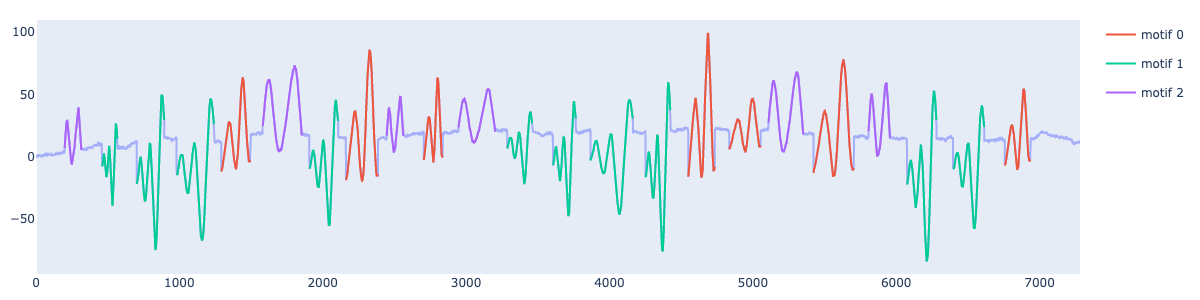
Example 1 (Motifs of same average size, number of occurences randomly selected within an interval)
from tsmd.tools.synthetic_signal import SignalGenerator

generator=SignalGenerator(n_motifs=3, motif_length=200, motif_amplitude=2, motif_fundamental=3,
                           noise_amplitude = 0.5, length_fluctuation=0.5, amplitude_fluctuation=0.5,
                           sparsity=0.5, sparsity_fluctuation=0.5, walk_amplitude=0.2,
                           min_rep=5, max_rep=10)
signal,labels= generator.generate()
generator.plot()
Example 2 (Motifs of different average size, fixed number of occurences and total time series length)
generator=SignalGenerator(n_motifs=3, motif_length=[100,200,500], motif_amplitude=2, motif_fundamental=3,
                        noise_amplitude = 0.5, length_fluctuation=0.5, amplitude_fluctuation=0.5,
                        sparsity=0.5, sparsity_fluctuation=0.5, walk_amplitude=0.2,
                        exact_occurences=[4,10,3],exact_ts_length=5000)
signal,labels= generator.generate()
generator.plot()